Article
Mar 28, 2026
Battery Energy Storage Systems (BESS)
As India races toward 500 GW of renewable capacity, battery storage is emerging as the critical bridge between intermittent green power and a stable, reliable grid.
Executive Snapshot
Battery Energy Storage Systems (BESS) have quickly come to be seen as an important enabler of the global energy transition as the power sector integrates increasing levels of variable renewable energy. With solar and wind power growing at unprecedented levels, the need for flexible storage solutions to balance supply and demand in real-time has become increasingly important. The Indian government’s goal of achieving 500 GW of non-fossil fuel-based capacity by 2030 has further heightened the strategic significance of storage infrastructure. Experts consider BESS to be the ‘missing link’ that enables the transformation of intermittent renewable power into reliable, dispatchable power, thereby facilitating both energy security and decarbonization goals. By 2029-30, the contribution of renewable energy to power generation is expected to increase dramatically from 18% to 44%, while the contribution of thermal energy is expected to fall from 78% to 52%.
What is BESS?
A Battery Energy Storage System is an electrochemical system that stores electricity in rechargeable batteries and releases it when required. A typical BESS installation consists of battery modules, a battery management system (BMS), power conversion systems (PCS), thermal management units, and energy management software. Lithium-ion batteries currently lead the way in terms of adoption with 92.15%, owing to their high energy density and falling costs, although other technologies such as flow batteries and sodium-ion batteries are being explored. By charging during times of excess generation and discharging during times of peak demand, BESS acts as a flexible buffer in the modern power grid.
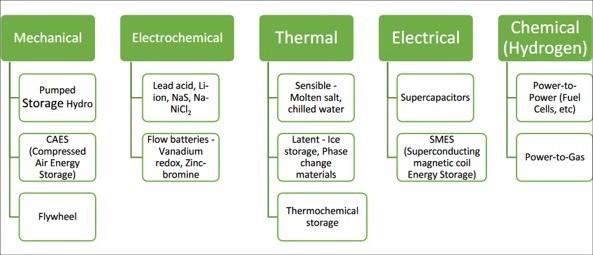
There are several energy storage technologies available, broadly - mechanical, thermal, electrochemical, electrical and chemical storage systems, as shown below:
Why BESS Matters Now
As per National Electricity Plan (NEP) 2023 of Central Electricity Authority (CEA), the energy storage capacity requirement is projected to be 82.37 GWh (47.65 GWh from PSP and 34.72 GWh from BESS) in the year 2026-27. This requirement is further expected to increase to 411.4 GWh (175.18 GWh from PSP and 236.22 GWh from BESS) in the year 2031-32.
Further, CEA has also projected that by the year 2047, the requirement of energy storage is expected to increase to 2380 GWh (540 GWh from PSP and 1840 GWh from BESS), due to the addition of a larger amount of renewable energy in light of the net zero emissions targets set for 2070.
Key Growth Drivers & Its Impact
Drivers | (~) % Impact on CAGR Forecast: | Geographic Relevance | Impact Timeline |
Declining lithium-ion battery costs | 8.50% | National; early benefits in Gujarat, Rajasthan, Karnataka | Medium term (2-4 years) |
Government VGF and PLI incentives | 7.20% | National; centered on manufacturing hubs in Gujarat and Tamil Nadu | Short term (≤ 2 years) |
500 GW renewables target creates storage gap | 9.30% | National; led by solar-rich Rajasthan, Gujarat, Andhra Pradesh | Long term (≥ 4 years) |
Mandatory Energy Storage Obligation for DISCOMs | 6.10% | National; phased in Rajasthan, Maharashtra, Karnataka | Medium term (2-4 years) |
Surge of multi-hour standalone tenders | 5.80% | National; anchored by SECI | Short term (≤ 2 years) |
Peak-tariff arbitrage for C&I and data centers | 4.90% | Urban and industrial clusters | Short term (≤ 2 years) |
Impact on the Renewable Energy Ecosystem
Grid Operators
For transmission and system operators, BESS offers fast-response frequency regulation, voltage support, and peak shaving services. The storage system can react in milliseconds, which is a major improvement over the stability of traditional thermal power stations.
Renewable Developers
For solar and wind energy developers, the co-located storage solution enables “firm and dispatchable” renewable energy, which enables the plant to supply electricity even when it is not generating any and allows them to command higher tariffs in joint bids.
DISCOMs and Utilities
The distribution companies will benefit from the reduced costs of peak-hour procurement and enhanced load management. The storage solution will also enable the postponement of costly transmission and distribution network expansions to meet peak demand.
Overall, the BESS solution enhances the entire renewable value chain.
Implications for Key Stakeholders
Battery Energy Storage Systems (BESS) installation in India has significant strategic implications for the Indian renewable market. The Indian government and state governments consider the installation of Battery Energy Storage Systems a key factor in achieving the non-fossil capacity of 500 GW by 2030 and net zero by 2070. The Viability Gap Funding Scheme of ₹5,400 crore for the installation of a capacity of 30 GWh, along with the extension of waivers for the cost of the charge of the Inter-State Transmission System until 2028, has made the project viable. However, in order to make it sustainable, it is necessary to stack the revenue to make it viable.
The opportunity for growth is huge for private investors and corporates, with a potential market size of USD 42 Billion by 2032 in manufacturing, EPC, and asset ownership. The Production Linked Incentive Scheme of Rs. 18,100 Crore for Advanced Chemistry Cells and the expanded tax code will also provide better bankability. The pace of technological advancement and the reduction in battery costs also make the project prone to obsolescence, hence the need for diversified risk exposure.
The manufacturer benefits from the localization incentives that focus on minimizing the high dependence on imported cells, which are currently imported from China. Financial institutions benefit from the improved PPA and VGF risk mitigation. BESS is expected to attract ₹33,000 crores of investments by 2028. Commercial and industrial consumers, such as data centers, benefit from the peak tariffs and improved reliability, though capex is a constraint.
Stakeholder | Opportunity | Risk | Strategic Implication |
Central/State Govts | Energy security, policy alignment | Fiscal burden | Mandate storage obligations, VGF scaling |
Private Investors | High CAGR, USD 42B market | Tech obsolescence | Diversify into value chain |
Manufacturers | PLI benefits, localization | Import dependency | Build domestic capacity |
Financial Institutions | Bankable PPAs, ₹33,000 Cr inflows | Execution delays | Revenue stacking models |
Consumers (C&I) | Peak shaving, reliability | Upfront costs | Demand-led tenders |
Why the Push Now?
The surge in the adoption of Battery Energy Storage Systems (BESS) in India is far from coincidental; rather, it is the outcome of the confluence of several factors, including the commitment to combat the effects of climate change, the fall in the cost of batteries, the need to ensure the stability of the grid, and the threat to energy security. This is a structural shift in the sense that battery storage is now a need rather than an option.
India’s commitment under the Paris Climate Agreement of 2015 to reduce the emissions intensity of its economy by 33-35% by the year 2030, compared to the year 2005, has now been translated into the 500 GW non-fossil power goal and the ‘Panchamrit’ goals announced at the Glasgow Climate Summit under the umbrella of COP26, which include the commitment of achieving net-zero emissions by the year 2070. The need for battery storage has thus become of immense significance as the share of renewable energy increases to 50% of the power mix of the country.
In the global scenario, the need to address the issue of grid stress has been highlighted by the occurrence of grid stress events, which has emphasized the need to incorporate storage solutions. This has been emphasized by the International Energy Agency, which has highlighted the need to incorporate storage solutions in systems that incorporate a high amount of renewable energy to avoid any imbalances. In the context of India, the need to incorporate storage solutions has been highlighted by the fact that the country is currently experiencing a renewable curtailment of 2 to 3 TWh. Further, the energy price shock caused by the Russia-Ukraine conflict has emphasized the need to develop energy independence, as the country is currently dependent on imported fossil fuels, which account for 85% of oil and ~50% of natural gas.
Most importantly, economic viability is a guide to action. The cost of lithium-ion batteries has declined by nearly 89% since 2010, currently at ~USD 132/kWh, which is expected to decrease further. Moreover, the institutionalization of policies such as VGF, PLI Scheme for Advanced Chemistry Cells, Energy Storage Obligations, and waivers on ISTS has provided momentum.
This convergence of climate targets, affordability, grid stability, and energy security explains why the push for BESS is happening now.
Global Benchmarking
While the deployment of India’s Battery Energy Storage System (BESS) is behind the global frontrunners, the pace at which the deployments are being added through policy-supported tenders, along with the provision of viability gap funding, is quite high. Although India has an existing capacity of 1 to 2 GW of grid-scale storage, the tendered capacities are already above 10 GW.
China is the current leader in the deployment of battery storage systems, with the majority of the installations in the recent past. This is attributed to the fact that the Chinese economy is driven by a mandate to integrate renewable systems with storage, lithium-ion manufacturing, and the presence of subsidies in the Chinese provinces. The Chinese model of battery storage systems is a centralized model.
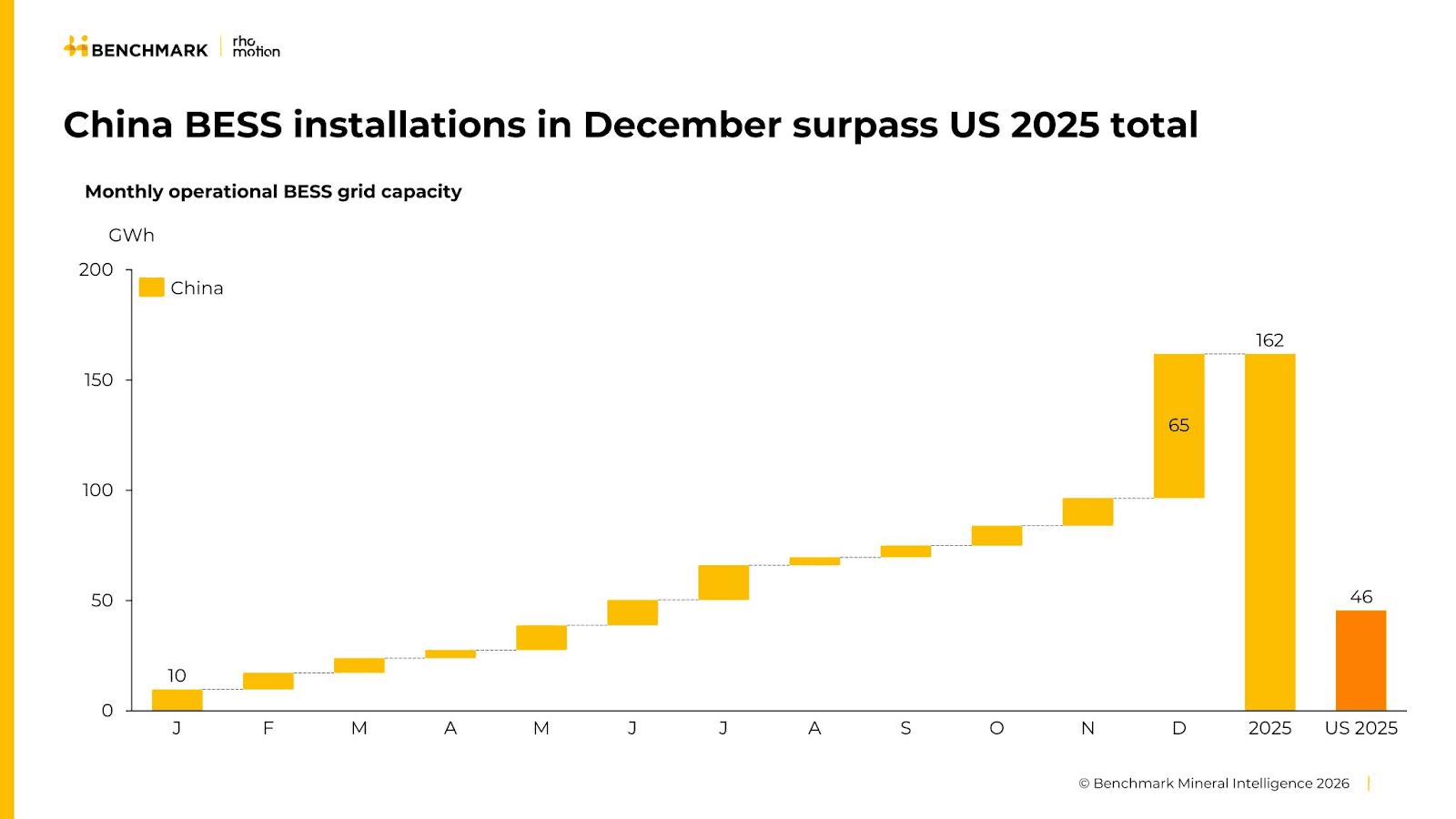
The United States follows a market-based approach with support from the Inflation Reduction Act, which offers a tax credit of 30-50% for investments in storage. Utility-scale battery investments are leading the charge, fueled by the existence of wholesale markets and capacity payments.
In Germany, they focus on renewable balancing, which is characterized by high penetration levels of solar and wind power, whereas Australia is improving grid stability, especially after blackouts, through investments in large-scale battery storage systems.
These markets represent a more mature regulatory-driven market approach.
Country | Installed Capacity (GW, ~2025) | Policy Model | Market Maturity |
China | 215 | State-driven subsidies | Advanced |
USA | 82 | Market + IRA incentives | Advanced |
Germany | ~6 | Renewable balancing | Mature |
Australia | ~8 | Frequency mandates | Mature |
India | ~1.5 | Tender-driven VGF/PLI | Emerging |
Compared to these leaders, India is at an emerging phase, policy-driven, tender-based, and manufacturing-aspirational. However, the roadmap and the pipelined growth rate suggest that convergence with the mature markets can become a reality within the next ten years.
Risks and challenges
Even with the policy thrust, the scaling up of BESS in the country is hindered by quantifiable structural challenges that affect its commercial viability.
Firstly, the capital cost of the BESS is still in the range of 200-300 $/kWh due to the import-intensive nature of the system’s configurations. While the discovered tariffs have reduced to 2.1 INR/kWh in 2025, the funding is still cautious due to high interest rates.
The technical capability also affects the viability of the project. For lithium-ion batteries, the useful life is 10-15 years with an annual degradation of 1-2% of the battery’s capacity. Without proper warranties and guarantees, long-term bankability is also a problem.
Safety, however, is something which cannot be ignored, even if it can be controlled. In the event of Thermal Runaway fires, which are quite rare, the need for the battery to be equipped with sophisticated Thermal Management Systems (TMS) and the need to follow stringent guidelines arise in the context of grid-scale deployments.
Environmental and Supply Chain Risks: The Indian battery market is still in the developmental stage, and the country lacks native recycling capabilities, which, if not disposed of properly, could lead to the pollution of lithium and cobalt resources. Moreover, the country imports 80% of the battery cells from China.
Regulatory challenges: Changes in regulations, coordination between the central government and states, absence of proper valuation of services such as T&D deferral, and poor DISCOM balance sheets remain a deterrent for investors.
Risk Type | Description | Severity | Mitigation |
Economic | High capex USD 200-300/kWh | High | VGF, PLI incentives |
Technical | Degradation over 10-15 years | Medium | R&D, warranties |
Safety | Thermal runaway fires | High | TMS, standards |
Environmental | Recycling/mining gaps | Medium | Circular policies |
Supply Chain | 80% China import dependence | High | Domestic manufacturing |
Regulatory | Framework inconsistencies | Medium | ESO, clear valuation |
Future Outlook: The Next Decade of BESS
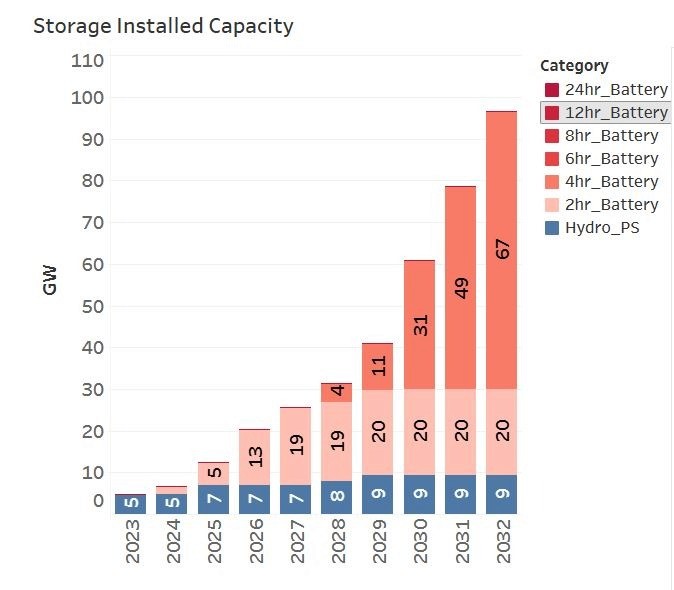
The BESS market in India is expected to see structural growth. According to the Central Electricity Authority, the battery storage market in India is expected to reach 236 GWh by 2031-32, as part of a total storage market of 411 GWh. This is in line with India’s 500 GW target for renewable energy. The long timescales indicate that India’s battery storage market could reach 1,800+ GWh by 2047, in line with India’s 2070 net-zero target.
The market size of the battery storage market is expected to be between ₹3.5-5 lakh crore by 2030-32, as per the estimates by NITI Aayog. 44-47 GW capacity additions in the battery segment are expected to be completed by the end of this decade. Grid-scale hybrid projects, such as solar-wind-BESS, are being prioritized.
Technology evolution is also one of the factors for costs and scale, as sodium-ion batteries, being 20-30% cheaper and having the potential to be priced as low as $50-70/kWh, are also considered a replacement for stationary storage solutions, with pilot projects currently being implemented with the aim of commercializing the product by 2027-28, thus reducing dependence on lithium-ion batteries. Solid-state batteries, being more dense and safe, will be ready for commercialization trials after 2028 with the evolution of R&D globally.
Another factor is the domestic manufacturing sector. The PLI scheme announced for ₹18,100 crore for 50 GWh capacity ACC battery manufacturing, increased VGF support for 30 GWh capacity, and localization at 40% by 2030 will help the country overcome the import challenge.
If the BESS plan is successfully implemented, the intermittent nature of renewable energy will be replaced with reliable and dispatchable clean energy, which will shape the power industry’s evolution in the next decade.
Strategic Conclusion
Battery Energy Storage Systems (BESS) are no longer an afterthought for renewables, they are now an integral part of the system. Therefore, as India continues its charge towards achieving 500 GW of renewables and its 2070 net-zero target, BESS will determine if the growth in renewables results in actual reliability and economic security, or if the growth in renewables results in curtailment, volatility, and inefficiency. BESS ensures that renewable power is firm, dispatchable, and reliable.
Three strategic realities have now become very clear.
First, BESS will determine the success of renewables. Solar and wind capacity additions alone are no longer enough.
Second, domestic manufacturing is critical. Cutting down import dependence and developing domestic supply chains, including Advanced Chemistry Cell manufacturing, would be a defining factor in India’s success in the global BESS market.
Third, a need has been felt to align policies with private capital. Although schemes like PLI, VGF, and ESO provide direction, it is expected that execution, financial innovation, and investor confidence would drive the show.
The next decade is a critical period. This is a make-or-break scenario for India to grow from a storage-dependent importer dependent on global supply chains to a global leader in storage, leading global markets in energy and storage.
Sources:
IBEF. Power sector in India. https://www.ibef.org/industry/power-sector-india
Ministry of New and Renewable Energy. (n.d.). Energy storage systems (ESS) overview. https://mnre.gov.in/en/energy-storage-systemsess-overview/
Mordor Intelligence. India battery energy storage systems market. https://www.mordorintelligence.com/industry-reports/india-battery-energy-storage-systems-market
ESZoneo. (2026). India’s battery energy storage systems boom: Opportunities, policies, and the road ahead. https://eszoneo.com/info-detail/indias-battery-energy-storage-systems-boom-opportunities-policies-and-the-road-ahead-for-2026-2026
DCNT Global. (2026). Budget 2026 roadmap for India data center market and BESS. https://www.dcntglobal.com/budget-2026-roadmap-for-india-data-center-market-and-bess/
HTPL. Battery energy storage systems (BESS) industry in India: Market analysis and future outlook. https://www.htplonline.com/battery-energy-storage-systems-bess-industry-in-india-market-analysis-and-future-outlook/
CFI Group. (2025). BESS: India’s outlook. https://www.thecfigroup.com/wp-content/uploads/2025/02/BESS_Indias-Outlook_CFI.pdf
CleanTech Hero. Battery energy storage systems (BESS) in India. https://cleantechhero.com/battery-energy-storage-systems-bess-in-india/
Mordor Intelligence. India battery energy storage systems market: Companies. https://www.mordorintelligence.com/industry-reports/india-battery-energy-storage-systems-market/companies
Vasudha Foundation. Assessing the development of battery energy storage systems in India. https://vasudha-foundation.org/wp-content/uploads/Assessing-the-Development-of-Battery-Energy-Storage-Systems-in-India.pdf
Energy Central. Why BESS is critical for India’s net zero mission. https://www.energycentral.com/energy-biz/post/why-bess-is-critical-for-india-s-net-zero-mission-ZA2B28TbHeOiLP6
Energetica India. The role of BESS in India’s renewable energy goals. https://www.energetica-india.net/articles/the-role-of-bess-in-indias-renewable-energy-goals-facilitating-renewable-integration-and-grid-stability
ReConnect Energy. India’s BESS boom and policy challenges. https://www.reconnectenergy.com/indias-battery-energy-storage-systems-boom-and-what-policy-must-get-right-next/
Drishti IAS. Future-proofing India’s energy security. https://www.drishtiias.com/daily-updates/daily-news-editorials/future-proofing-indias-energy-security
Institute for Energy Economics and Financial Analysis.India’s battery storage boom: Getting execution right. https://ieefa.org/resources/indias-battery-storage-boom-getting-execution-right
Benchmark Mineral Intelligence. https://source.benchmarkminerals.com/?camefrom=rhomotion.com
ESS News. (2026). Global BESS demand jumps 51% in 2025. https://www.ess-news.com/2026/01/20/global-bess-demand-jumps-51-in-2025-as-installations-top-300-gwh/
BloombergNEF. Global energy storage boom: Three things to know. https://about.bnef.com/insights/clean-energy/global-energy-storage-boom-three-things-to-know/
Fairfield Market Research. Battery energy storage system market. https://www.fairfieldmarketresearch.com/report/battery-energy-storage-system-market
Visual Capitalist. Top 20 countries by battery storage capacity. https://elements.visualcapitalist.com/top-20-countries-by-battery-storage-capacity/
AInvest. (2026). India’s green energy ambitions and BESS manufacturing shift. https://www.ainvest.com/news/india-struggling-green-energy-ambitions-critical-reliance-pivotal-shift-cell-manufacturing-bess-2601/
Sharma, S. #100Days100BESSLearnings (LinkedIn post). https://www.linkedin.com/posts/shubham-sharma-solarenergy_100days100besslearnings-besschallenges-activity-7353986031437692929-FloG
Energy Central. (2025). Battery energy storage systems: Future of energy storage in India. https://www.energycentral.com/renewables/post/battery-energy-storage-systems-bess-future-energy-storage-india-2025-C8sZ5q64xf4QxXl
PMF IAS. Battery energy storage systems. https://www.pmfias.com/battery-energy-storage-systems/
The Economic Times. (2026). India’s battery storage to reach 66 GW by 2032. https://energy.economictimes.indiatimes.com/news/power/indias-battery-storage-to-reach-66-gw-by-2032-5-lakh-crore-investment-opportunity-report/118372354
Institute for Energy Economics and Financial Analysis. India’s battery storage boom: Getting execution right. https://ieefa.org/resources/indias-battery-storage-boom-getting-execution-right
UC Berkeley (IECC). Strategic pathways for energy storage in India through 2032. https://iecc.gspp.berkeley.edu/resources/reports/strategic-pathways-for-energy-storage-in-india-through-2032/
Authors
Dev Raj
Kushal Kumar