Article
Jan 10, 2026
From Rulebooks to Revenue
Why regulatory compliance is no longer a cost center but a growth strategy.
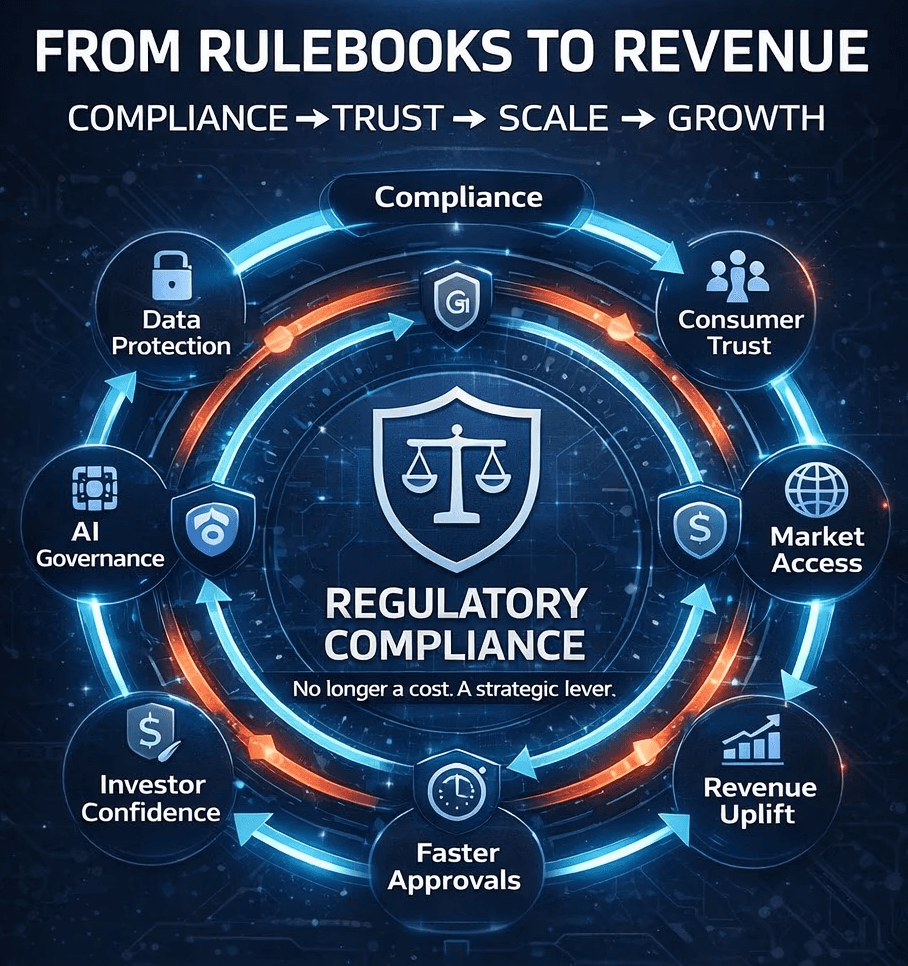
For much of corporate history, legal compliance occupied a predictable yet peripheral role within an organizations. It was regarded as a necessary expenditure, an operational safeguard designed to minimize exposure to penalties, litigation, and reputational damage. Compliance functions operated largely in isolation, activated primarily in response to regulatory scrutiny or internal crisis. Their mandate was defensive, reactive, and seldom integrated into strategic decision-making.
That perception is now rapidly eroding. In contemporary markets shaped by regulation, transparency, and trust, legal compliance is no longer confined to risk avoidance. Its is increasingly influencing how firms scale, secure capital, build consumer confidence, and sustain competitive advantage. What was once dismissed as a cost center is emerging as a decisive growth enabler.
The Traditional View: Compliance as a Cost Burden:
Historically, compliance was framed through the narrow lens of loss mitigation. Investmentsin legal infrastructure were justified by the need to meet statutory requirements and avert financial or legal repercussions. The absence of immediate, measurable returns reinforced the belief that compliance added little strategic value.
This mindset was shaped was shaped by relatively stable regulatory environments, uneven enforcement mechanisms, and market conditions that rewarded speed and expansion over governance. Compliance therefore evolved into a back-office function- essential, yet detached from commercial priorities.
Even as enforcement intensified and penalties escalated, compliance largely retained its reactive character. It remained a mechanism for damage control rather than a driver of organizational value.
The Shift: Regulation as a Market Shaping Force:
The contemporary regulatory landscape has fundamentally altered this equation. Laws governing data protection, financial integrity, environmental disclosures, and consumer rights no longer operate at the margins of economic activity. They actively structure markets and redefine competitive boundaries.
Regulation today determines market participation. Firms that fail to meet compliance thresholds face restricted expansion, delayed approvals, and erosion of stakeholder confidence. Conversely, organizations that demonstrate regulatory maturity are increasingly rewarded with institutional trust, investor confidence, and preferential market access.
This transformation reflects a broader economic reality: trust has become a scarce and valuable asset. In digitized and cross border markets, where transactions are often intangible- compliance frameworks function as institutional trust building mechanisms. Regulation, rather than merely constraining behavior, now underpins the market legitimacy.
How Compliance generates Competitive Advantage:
Consumer trust and brand differentiation-
In data driven and consumer facing sectors, compliance directly shapes brand credibility. Robust privacy safeguards, transparent disclosures, and consumer protection mechanisms signal accountability and reliability. Firms that embed compliance into product architectureand service delivery position themselves as trustworthy custodians of consumer interests.
Overtime this trust translates into differentiation. In saturated markets with marginal product variation, regulatory credibility can influence consumer choice more decisively than price or innovation alone. Compliance, when leveraged strategically, becomes an integral component of brand equity.
Capital access and firm valuation-
Investor perceptions are increasingly shaped by regulatory preparedness. Governance standards, disclosure practices, and compliance risk profiles now form a core part of due diligence processes. Firms with institutionalizes compliance frameworks are viewed as lower risk investments, enabling more favorable capital access and valuation outcomes.
This trend is particularly visible in ESG- linked investment strategies. Companies that align early with governance and reporting norms are better positioned to attract long-term capital, while regulatory laggards face heightened scrutiny and capital constraints. Compliance thus serves as a signal of strategic foresight and organizational resilience.
Market entry and scalable growth-
For forms operating across jurisdictions, compliance is a prerequisite for scalability. Regulatory alignment facilitates smoother market entry, reduces friction in licensing and approvals and minimizes operational disruptions. Compliance failures, by contrast, impose delays, inflate costs, and often necessitate structural overhauls.
Organizations that integrate legal foresight into expansion strategies gain a decisive advantage. By anticipating regulatory evolution, they design scalable business models rather retrofitting compliance after growth has occurred.
Industry Snapshots: Compliance in Practice:
In the Financial Technology sector, firms that proactively engaged with regulators established credibility and scaled sustainably, while those that deprioritized compliance encountered operational suspensions and erosion of consumer trust. Early regulatory alignment enabled compliant firms to secure partnerships, institutional funding, and long terms user loyalty by signaling lower regulatory risk and operational maturity.
This shift reflected in how fintech firms allocate resources. Globally compliance and legal spending in financial services has risen steadily over the past decade, with industry estimates indicating that large financial institutions now spend 8-10% of their operating costs on compliance-related functions, compared to under 5% in the early 2020s. this increase reflects the growing recognition that regulatory readiness directly influences scalability and investor confidence.
A similar trend in evident across India’s banking and financial services sector, where heightened regulatory oversight has driven a surge in senior legal and compliance appointments. Banks, NBFCs and financial sponsors are increasingly appointing general counsels and chief legal officers not merely to manage disputes, but to embed compliance into strategic and operational decision making. This shift is mirrored in rising legal expenditure: in FY’25, NIFTY 500 companies reported legal expenses exceeding ₹62,146 crore, with financial services firms accounting for a significant scare- underscoring how compliance has evolved into a deliberate operational investment rather than a peripheral cost.
Technology platforms illustrate comparable dynamics. Companies that invested early in privacy centric data governance adapted more smoothly to evolving regulatory expectations, avoiding costly restructuring and reputational fallout. Late adopters, by contrast, faced reactive compliance costs, enforcement pressure, and diminished market confidence. Following the introduction of comprehensive data protection regimes globally, surveysindicate a 30-50% increase in in-house legal and compliance hiring, particularly in roles focused on data protection, governance, and regulatory affairs.
Across industries, governance failures have repeatedly demonstrated how compliance lapses can erode market value almost instantaneously. Empirical analysis of corporate crisis suggest that firms with weak internal controls experience sharper and more prolonged market value declines, while those with robust compliance frameworks recover significantly faster- underscoring compliance not merely as a safeguard, but as a stabilising force in volatile markets.
The Rise of Corporate law and Institutionalisation of Compliance:
These shifts reflect a fundamental reorganisation of legal and compliance functions within firms. Over the past decade, corporate law has moved from a peripheral support role to a core strategic function, evidenced by the growing reliance on in house lawyers, company secretaries, and specialised compliance professionals embedded directly within business operations.
Hiring trends underscore this transition. In India, corporate legal and compliance roles are among the fastest-growing segments of the legal profession, with in-house legal teams at large corporations expanding by over 40% in the past seven to eight years. Demand has been particularly strong for company secretaries, regulatory compliance officers, and governance specialists. Globally, multinational firms now employ two to three times more in house lawyers than they did in the early 2000s, reflecting a decisive shift toward continuous internal oversight.
Regulatory expansion has been central to this evolution. Frameworks governing data protection, competition, corporate governance, and financial conduct now impose ongoing obligations rather than episodic compliance checks. Laws such as the Digital Personal Data Protections act, 2023 strengthened competition oversight, and stricter disclosure norms have elevated legal involvement at the stages of product design, platform governance, and strategic planning.
As a result, corporate law functions now extend beyond contract management or dispute resolution. Legal and compliance teams increasingly shape risk anticipation, market entry, merger strategy and long long-term growth decisions. This institutionalisation of compliance reflects a broader recognition that regulatory exposure is no longer exceptional, but a permanent feature of modern business environments.
Global developments reinforce this shift. In the European Union, comprehensive data protection regulation compelled firms worldwide to restructure governance systems and expand compliance capabilities. Organisations that aligned early adapted more efficiently, while late adopters faced enforcement action and operational disruption dynamics now increasingly visible across other regulatory markets, including India.
Conclusion:
The repositioning of regulatory compliance from a defensive obligation to a strategic asset reflects a fundamental shift in how modern firms compete. In markets shaped by regulation, transparency, and trust, compliance now influences scalability, capital access, and long term credibility. What was once a back-office function has become a core determinant of organisational resilience and growth.
Firms that integrate legal foresight into strategy are better equipped to anticipate regulatory change and convert compliance into competitive advantage, while those that treat it as a peripheral cost face increasing strategic constraints. As regulation continues to redefine market dynamics, sustainable growth will depend not on reactive adherence, but on proactive alignment.
As Peter Drucker observed, “The best way to predict the future is to create it.” In today’s regulatory environment, firms that recognise compliance as a growth strategy will be the ones shaping the future of their markets.
References:
• Porter, M. E., & Kramer, M. R. (2011). Creating Shared Value. Harvard Business Review
https://hbr.org/2011/01/the-big-idea-creating-shared-value
• OECD (2020). Corporate Governance and Compliance Risk
https://www.oecd.org/corporate/corporate-governance-and-compliance-risk.htm
• Deloitte (2023). The Rising Cost of Compliance in Financial Services
https://www2.deloitte.com/global/en/pages/financial-services/articles/regulatory-compliance-costs.html
• PwC (2022). Global Compliance Study
https://www.pwc.com/gx/en/services/risk-assurance/compliance.html
• NIFTY 500 – NSE India (FY25 Corporate Disclosures)
https://www.niftyindices.com/indices/equity/broad-based-indices/nifty-500
• Vahura & Lawctopus (2023). In-House Legal Hiring Trends in India
https://www.lawctopus.com/in-house-legal-hiring-trends-india/
• European Commission. Data Protection and GDPR Implementation
https://commission.europa.eu/law/law-topic/data-protection_en
• McKinsey & Company (2021). Data Governance, Trust, and Competitive Advantage
https://www.mckinsey.com/capabilities/risk-and-resilience/our-insights/data-governance-the-key-to-building-trust
• BlackRock (2022). Investment Stewardship Report
https://www.blackrock.com/corporate/about-us/investment-stewardship
• World Economic Forum (2020). The Global Risks Report
https://www.weforum.org/reports/the-global-risks-report-2020
Author:
Arushi Mishra