Article
Dec 5, 2025
The Illusion of Expertise: Unpacking Conflicts, Credibility, and Regulation in the world of Finfluencers
Finfluencers promise quick riches, but 56% lose money while raking in followers & commissions. This deep dive uncovers the psychology, scams, and SEBI crackdowns behind the hype. Will you follow the crowd or invest wisely?

Introduction
In an age where a 60-second reel can move markets, financial wisdom has become a performance. The new gurus of money do not sit in boardrooms, they stream, post, and go viral. The increasing influence of financial content creators, known as finfluencers represents a shift in how young individuals educate themselves about money. What began as readily available online guidance has evolved into a powerful, often unpredictable alternative, to traditional financial counsel. Their emergence, not solely driven by knowledge, was shaped by technological progress, post-pandemic unpredictability and a generation seeking accessible financial guidance. Social media platforms filled the trust gap left by official advisors as millions of new retail investors entered the markets. Finfluencers projected a sense of relatability, self-assurance, and emotional transparency when they first entered this market. But beneath their relatable tone and confident persona lies a deeper question: how reliable is this new wave of financial expertise?
The Rise of Finfluencer Culture
The emergence of finfluencers was no coincidence; it was driven by the interplay of financial hardship, online accessibility and social media trends during and following the COVID-19 lockdowns. When the globe shut down in 2020 individuals experienced increased savings, reduced spending and significant concern about their earnings. In India this unpredictability sparked a surge in retail investors: unique registered investors soared from 1.5 crore in 2013 to more than 11 crore by 2023.
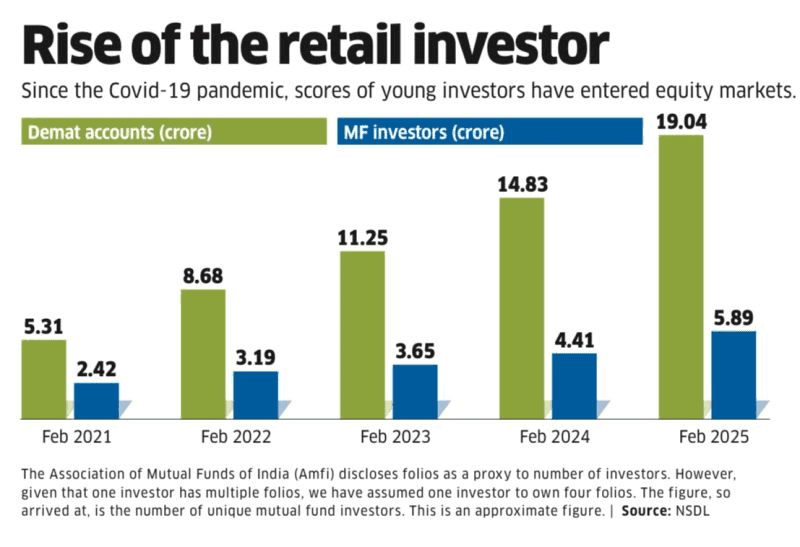
From just 4 crore demat accounts in 2020 to 14 crore demat accounts in 2024, over 10 crore new investors joined the capital market during this tenure. Technology eliminated the obstacles. Platforms such as Zerodha, Upstox and Groww transformed investing into a two-minute activity on smartphones increasing the average daily trading volumes from ₹48,000 crores in early 2020 to over ₹1,04,000 crores by late 2024. However technology by itself cannot account for why countless people placed their confidence in individuals online for financial guidance. While conventional advisors provided jargon-filled reports, finfluencers offered their insights through narratives, humor and emotional connection. A 2024 CFA Institute study revealed that 38% of Gen-Z investors depended on influencers when making investment decisions, not due to expertise but because these creators "seemed relatable.” Research in 2025 further shows that finfluencers excel at building informal, intimate storytelling environments, where admissions of personal failures create parasocial relationships that feel safer than formal consultations.
The Psychology Behind Finfluencer Credibility
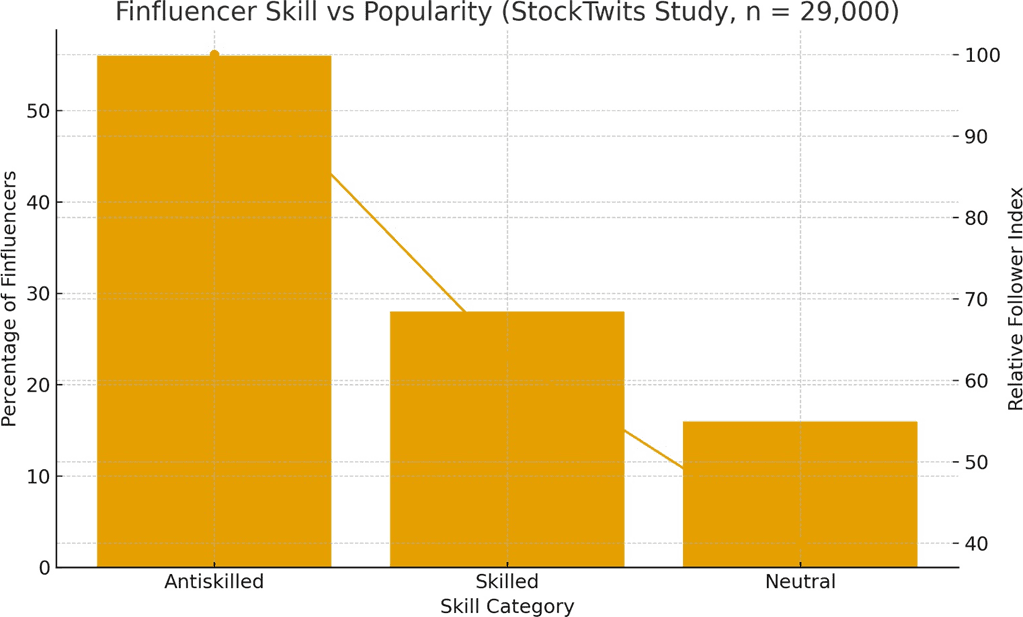
Finfluencers rarely gain influence through genuine skill; they rise by performing expertise. A study of 29,000 StockTwits creators shows the paradox clearly: 56% are “antiskilled,” generating negative monthly returns of -2.3%, yet they attract the largest audiences. Only 28% produce modest positive returns. This reversal exists because influential creators exploit predictable cognitive biases such as homophily (trust in similar individuals) and FOMO, fabricating an image of reliable success through cherry-picked screenshots, exaggerated confidence, and relatable storytelling.
The deception deepens through carefully crafted visual authority. Curated screenshots, polished aesthetics, vague credentials, and exaggerated confidence create a veneer of mastery detached from actual performance. A 2023 University of Minnesota audit found 65% of TikTok finance content implies guaranteed returns without disclaimers, revealing how these creators rely on perception rather than proof. In this ecosystem, confidence is mistaken for competence, allowing the least skilled voices to appear the most trustworthy.
How Finfluencers Profit From Your Losses
The concerning reality about finfluencers is that their whole business framework is founded on incentives promoting manipulation instead of truthfulness. The newest ASCI 2025 report shows that 76% of India’s financial influencers breached compulsory disclosure regulations, frequently concealing paid collaborations or embedding them subtly within hashtags. What seems like financial guidance is, in numerous instances, a cleverly concealed promotion.
SEBI’s July 2024 report clarifies the reason: numerous finfluencers receive commissions per investor from trading platforms. Their earnings increase not based on followers profits but on the frequency of followers’ trades in high-risk categories. Greater volatility leads to user turnover and increased payments for influencers. During its 2025 enforcement actions SEBI identified 15,000 unregistered finfluencers participating in these hidden affiliate programs vigorously promoting speculative stocks and hazardous derivatives to drive trading volume. As per a report of Moneycontrol on August 20, 2025, SEBI initiated a carefully coordinated raid at trading influencer Avadhut Sathe's training academy located in Karjat. The operation involved surveillance, pre-approved legal clearances and tracking of movements before execution. The regulator's team, led by a deputy general manager, carried out search and seizure actions that lasted until August 21, 2025. Digital devices, materials, and trading data were confiscated and are currently undergoing forensic investigation.
These actions are not oversights; they constitute clear breaches of the law. According to SEBI regulations anyone providing advice must be registered and must clearly disclose any sponsorships or incentives. Nevertheless 69% of leading creators completely disregard these rules portraying paid promotions as evaluations. In severe instances organized pump-and-dump operations have surfaced, with influencers stealthily acquiring shares artificially boosting their value online and then selling off for profit while their followers bear the losses.These actions are not “content experiments” or “marketing tactics.” They qualify as securities fraud under the SEBI Act, disguised behind relatable thumbnails and friendly social-media personas.
The Quiet Cost to Retail Investors
Numerous investors incur losses, occasionally as high as 95% of their capital similar to the scenario, with Gensol Engineering fueled by promoter exaggeration and influencer backing. Some examples as mentioned in an Economic Times Report such as Anurag Rawat incurring a 36% drop in Tejas Networks and Sandeep Shukla, from Hyderabad losing his ₹2.5 lakh investment through Telegram advice demonstrate severe personal monetary losses. Losses are compounded by youth and inexperience, with many new investors falling prey to the allure of quick gains promoted by influencers who often lack SEBI registration or transparency about their financial interests.
Studies tracking trading behaviors reveal that people who get investment advice from media trade 30-40% more frequently than those not influenced by these sources. This increased trading activity leads to transaction costs, amplifies timing errors and increases vulnerability to market volatility. Data indicates that portfolios constructed from influencer-driven decisions underperform market benchmarks by 1.5-3 percentage points annually due to excessive turnover rather than market changes.
The resulting harm is persistent yet dispersed. Losses are experienced privately by individual investors, while gains from increased activity are systematically accumulated by platforms and content creators. This asymmetry weakens accountability. Finfluencers retain credibility and visibility even when followers consistently underperform, illustrating how popularity has become detached from actual financial competence.
Regulation in a Digital Grey Zone
The Securities and Exchange Board of India (SEBI) enforces regulations on those authorized to offer investment guidance mandating registration as a Registered Investment Adviser (RIA). Solely SEBI-registered advisers have the authority to deliver personalized or particular investment suggestions. SEBI has released warnings cautioning the public against accepting advice from unregistered persons or organizations posing as specialists, on social media. In 2025 SEBI implemented measures by prohibiting unregistered finfluencers from incorporating live market data in their posts intending to curb deceptive day trading advice and promote transparency.
In spite of these efforts enforcement proves challenging because of the quantity of content creators changing social media landscapes and overlapping legal authorities. SEBI is collaborating with technology platforms such as Google and Telegram to restrict financial advice and fraudulent profiles. Enhancing investor education remains a focus to assist consumers in critically assessing financial information and depending on trustworthy sources instead of sensationalism. India is also part of international cooperative efforts, such as guidelines from IOSCO (International Organization of Securities Commissions), to harmonize regulation of financial advice on social media globally.
Conclusion
Financial freedom begins not with a click, but with clarity. As tempting as influencer content may seem, every investor owes themselves one responsibility, to question everything before they follow. The illusion of expertise thrives only when audiences surrender their skepticism. As Warren Buffett wisely said, “Risk comes from not knowing what you are doing.” In the digital age, where the number of finfluencers are increasing and investment advice is just a click away, this warning is more relevant than ever. Regulation can enforce boundaries, but smart judgement must come from within. Always ask: does this advice serve your growth, or someone else’s gain?
References
Barber, B. M., & Odean, T. (2000). The common stock investment performance of individual investors. The Journal of Finance, 55(2), 773–806. https://faculty.haas.berkeley.edu/odean/papers%20current%20versions/individual_investor_performance_final.pdf
Odean, T. (2023). Resolving a paradox: Retail trades positively predict returns but are not profitable. https://faculty.haas.berkeley.edu/odean/Papers%20current%20versions/resolving_a_paradox_retail_trades_positively_predict_returns_but_are_not_profitable.pdf
Kakhbod, A. (2023, July 5). Finfluencers. SSRN. https://papers.ssrn.com/sol3/papers.cfm?abstract_id=4428232
CFA Institute Research Foundation. (2024). Finfluencer appeal. https://rpc.cfainstitute.org/en/research/reports/2024/finfluencer-appeal
International Organization of Securities Commissions (IOSCO). (2025, May). Finfluencers. https://www.iosco.org/library/pubdocs/pdf/IOSCOPD795.pdf
Securities and Exchange Board of India (SEBI). (2024). SEBI Proposal https://www.sebi.gov.in/sebi_data/meetingfiles/jul-2024/1719916854117_1.pdf
Khaitan & Co. (2023, October 12). Finfluencers in the crosshairs: SEBI’s regulatory clampdown. https://www.khaitanco.com/sites/default/files/2023-10/Finfluencers%20In%20The%20Crosshairs%20SEBI%27s%20Regulatory%20Clampdown%20-%2012%20October%202023_0.pdf
Drishti IAS. (2022, Nov 19). Finfluencers. https://www.drishtiias.com/daily-updates/daily-news-analysis/finfluencers
Berchmans, M., & Vasanthi, S. (2025). Post-Covid Stock Market Participation in India. All Multidisciplinary Journal. https://www.allmultidisciplinaryjournal.com/uploads/archives/20250617154218_MGE-2025-3-392.1.pdf
Zerodha. (2025, January 10). The dramatic transformation of the Indian stock market. https://zerodha.com/z-connect/subtext/the-dramatic-transformation-of-the-indian-stock-market
Henriques, E. & Paes, R. (2025, March 28. The Rise of Finfluencers in India. Indian Journal of Innovation and Social Sciences. https://ojs.trp.org.in/index.php/ijiss/article/download/4848/7709/11146
Bajaj AMC. (2025, September 18). FOMO, hype, and headlines in investing. https://www.bajajamc.com/knowledge-centre/fomo-hype-headlines-investing
Bao Tran, H. (2025, October 10). The Influence of Finfluencer Authenticity and Trust on Gen Z’s Investment Intention. https://ijefm.co.in/v8i10/Doc/6.pdf
Hull, I. & Qi, Y. (2024, August 10). The Impact of Finfluencers on Retail Investment. SSRN. https://papers.ssrn.com/sol3/papers.cfm?abstract_id=4922031
India Brand Equity Foundation (IBEF). (2024, September 4). Rise of retail investors and domestic funds in India. https://www.ibef.org/blogs/rise-of-retail-investors-and-domestic-funds-in-india
Authors
Suvam Srivastava
Tanishq Agrawal
Kushal Kumar